Software development ethics: how to make decisions when AI writes code
A guide to accountability, privacy, licensing, accessibility, and challengeable decisions in AI-assisted software projects.
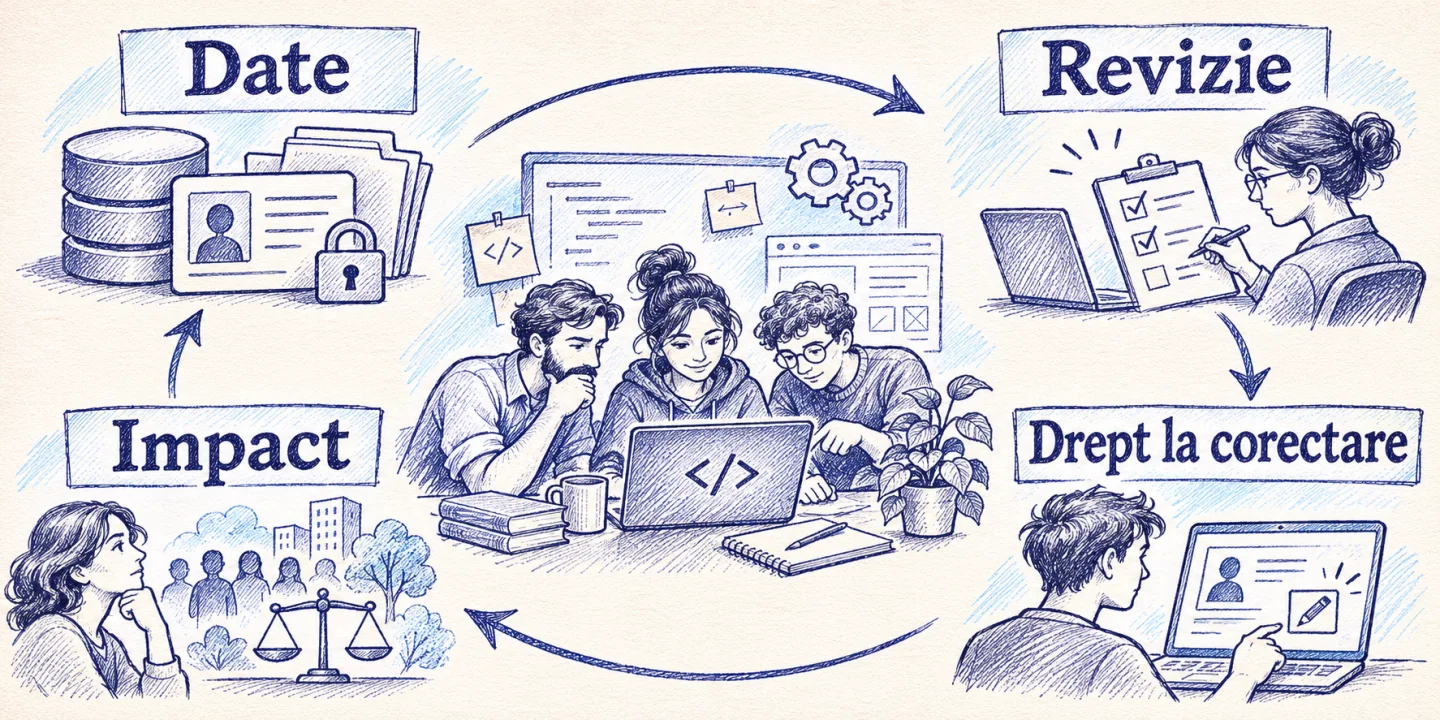
Ethics in software development is seen in the consequences of technical decisions. A retention period, a button that hides opt-out, or a change that breaks a client’s access affects real people. When AI contributes to code, design, or evaluation, the team needs to be able to explain who made the decision, from what information, with what checks, and what the user can do if the system goes wrong.
Morality here refers to the values by which people judge an action, such as fairness, dignity, and avoidance of harm. Professional ethics bind them to work rules and obligations. In a project, the practical difference is between saying you care about privacy and deciding who can see information, for how long, with what justification, and how access is recorded.
How do you identify people affected by a feature?
It starts with the most important decision that the function can influence. If you are designing a request portal, analyze who gets a response, who is delayed, and who is left without an explanation. In addition to the customer and buyer, consider the operator who fixes the cases, the person whose data appears in the document and the person who cannot use the standard route.
Draw two examples. The first can be a complete application, in the expected format. In the second, a person submitted documents in a different order, with a transcription error and an almost expired deadline. If the product automatically marks the application as incomplete, it finds out if the applicant knows what’s missing and can continue without restarting the entire process. This is where architecture, interface text and the right to correct meet.
He also asks who benefits from the time gained. A form can move ten minutes from the operator to each user. If the volume is high, this may only be a reasonable decision when the user in turn gets a faster or more predictable resolution. Check the impact on people who need an alternative format or assistance. An effective main route system must have a complete exception route as well.
Who is responsible for AI generated code?
The team that accepts and delivers the code is responsible for its behavior. A generated proposal goes through the same checks as any change. The reviewer must understand the scope, dependencies, effects on existing clients, and what happens when the operation fails before completion. If no one can explain a feature, decide whether to simplify it, rewrite it, or withdraw it from the change.
Imagine a patch that adds logging to help the support team. Functional tests pass. In production, the patch would copy addresses and request details to the log available to more teams than the original application. Risk occurs at the border between the legitimate purpose of troubleshooting and the data it does not need. A competent review asks who can read the log, if an identifier arrives for correlation, and when the data is deleted.
A good practice is to ask for small changes and explanations of behavior. In the description of the integration request, mention the important decision, the verified cases and any uncertainty that remains. Tests for permissions and partial states are worth writing with the expected behavior in mind. If both the implementation and the tests come from the same wrong assumption, they can confirm each other.
An incident should leave two distinct traces. The first is redress for the affected person. The second is a process change that reduces repetition, for example removing sensitive information from the log or introducing a revision when the collected data changes. NIST Practices for Secure Software Development
What data can you share with a development assistant?
The answer depends on the organization’s policy, contracts and how the tool operates. Before using it, find out what it retrieves: selected text, open files, conversation history, repository snippets or commands. Find out under what conditions this information is stored and who can access it. A configuration option must also be checked at the account or organization level, where it may have a different value than on the laptop.
For a question about the form of a query, use a fictitious schema when possible. For an external payload problem, build a minimal example that reproduces the business behavior without personal data. If the incident is based on a real case, use the approved medium and keep as much detail as possible at the source. Erasing a name rarely succeeds if identifiers, combinations of attributes, or free text easily associated with a person remain.
Separate learning examples from company material. A colleague can prepare a portfolio using a public project, synthetic entries and self-explanations. In the organization, a guide with allowed examples reduces situations where people are guessing. He can give alternatives for private repositories, support data, keys and materials received from customers.
What do you check when the proposal includes unknown libraries or code?
Check the package, source, actual usage and license obligations. A suggestion may include a package that does not exist, a deprecated dependency, or a library suitable for another runtime environment. The reviewer looks for the official documentation, checks if the feature is really needed, and records the reason if the project takes on a new component. Read the conditions that apply to the distribution or provision of the service in the context of the project and ask the legal officer when the situation is unclear.
If a generated fragment looks like a known implementation, check the provenance before integrating it. The conditions of an instrument are not an analysis of the compatibility of all materials that may appear in the result. A team can choose to write its own implementation from the public specification, use an approved attribution library, or obtain a suitable license. The choice has consequences for the source delivery and the person maintaining the project.
In the commit documentation, keep the list of relevant dependencies and update instructions. If the app provides an export, it explains what data it includes and how to re-import if this feature exists. Transfer to another team is also a test of professional ethics. Critical knowledge should not rest with the person who first set up the account.
How do you prevent hard-to-challenge decisions?
Separate classification from consequence. “Possible case incomplete” can be a signal to the operator. “Rejected application” changes the person’s situation. If the same output automatically leads to rejection, the system must be evaluated as part of the decision mechanism, including through the lens of applicable rules. A person challenging the result should be given a concrete route: see the relevant reason, complete the information and ask for reconsideration where appropriate.
Check if the explanation can be read independently. “Score below threshold” says too little. “Document not found among supported files, here are the allowed types and contact channel” allows the person to do something. If the reason is uncertain, the message should reflect the uncertainty and allow for manual processing. A clear answer should not expose the internal rules that protect other people or their data.
For a product review, track the differences between request types. If mobile forms receive multiple incomplete decisions, causes may include a document attachment error, an inaccessible component, or unrealistic assessment data. Analysis should use relevant segments and data that can be collected legitimately. It starts with observing situations, not concluding that users have filled in incorrectly.
Accessibility and autonomy are tested in the interface
A choice appears in the text, in the implicit behavior, and in the effort required by refusal. If accepting takes a click and declining forces the user to navigate through multiple screens, the design decision clearly favors one option. Where the choice must be free, the interface must effectively support both paths. It measures the success of the process after the user has expressed their choice, including when they decline a secondary function.
Take a keyboard-only tour, then check the labels, focus order, and feedback on an error. For a system that generates text in real time, reading each fragment can unnecessarily interrupt the user of a screen reader. It provides concise states and a predictable place to find the result. Provides the ability to stop generation and copy or edit the output when the process allows it. W3C Recommendation WCAG 2.2
If you’re tracking conversion, measure followers too. How many people cancel, return with complaints, or ask for help understanding the option? A team may find that the change that increases submissions also increases support time. For a sustainable result, the experiments include a criterion for the quality of agreement and a stop point if negative signals occur.
How do you document an ethical compromise?
It describes the context, the alternatives, the people affected, the remaining risks and who approved. For a digest service, a decision can record why you process the text within an approved account, what documents are excluded, and when the results are deleted. For a recommendation function, note whether the model can influence the priority, what evidence the operator sees, and how you check that a category is not always deferred.
Put the reassessment date in the document. A solution suitable for an internal pilot may become insufficient when the volume increases or the audience changes. Establish events that trigger the review: a new vendor, a new data category, switching to automatic execution, or a change in business purpose. It links the analysis to a specific responsible and to the place in the product where the function can be stopped.
For a small team, a one-page document may be sufficient. It can accompany a ticket and a code change. In discussions, ask what the affected person would think if they saw the reasoning, what data you could show them, and how they can disagree. These questions move the conversation from the area of intentions to the actual effects of the product.
How do you check if the product measurement is proportional?
For a drafting function, technical activity can be monitored by operation type, duration, and final status. The full transcript may be relevant to the investigation of a limited issue with a defined scope and access. Ask what product decision you can make from each category of data. If the team can see the errors without keeping the messages, use that option. If it needs examples, it decides what can be anonymized or aggregated and how copies are withdrawn.
Choose an indicator that describes results, not behaviors taken out of context. Time to complete a form can indicate friction. The amount of time each employee spends on the screen might as well say that they often stop to help colleagues. If the use of an indicator moves from product improvement to people evaluation, re-evaluate the purpose and access with the responsible people.
How do you revise a project under deadline pressure?
Imagine that before launch there is a difference between the data shown to the operator and the data sent to the client. The team has a few hours and must decide how much of the feature can remain active. Choose a version that reduces the consequence: keeps the internal draft, withdraws automatic sending and checks messages for a sample. Write down what was observed and who can reactivate the function after the patch. Thus, deadline pressure does not become the reason to hide the risk.
If the problem has already affected people, prepare a way to identify and fix cases. A good explanation tells specifically what result was incorrect and how it can be corrected. In addition to data recovery, it checks channel accessibility and how clearly a case can be traced. If the explanations only reach the administrator, the affected person may still receive wrong information.
Before the next similar term, turn the lesson into a launch condition. For external messages, check a representative request and interrupt case. For data changes, test proofreading and consulting the final version. In a small team, the list should be able to be used quickly, with examples that the product person also understands.
Frequently asked questions
Is it unethical to use AI when writing code?
Use can be responsible when it respects project rules, protects data, and undergoes risk-proportionate review. It matters if you can maintain the result and if users can be affected by mistakes. The tool’s terms of use and customer agreements may impose additional requirements.
When do you mention using AI?
When relevant to understanding the product or fulfilling an obligation, follow applicable rules and working agreements. A user interacting with an assistant should understand their role, what they can do, and when they can reach a person. For internal code, follow the project’s contribution policy and document the checks that matter to the commit.
What are you asking before the first release?
It asks who can be affected, how you detect a mistake, who retracts its effect, and what the alternate flow looks like. Ask for a complete example and an atypical one. For the legal perspective and controls specific to AI integrations, see guide on security, AI Act and GDPR.
Apply ethics in the next review
Choose an active function and track a request from entry to completion. Check what data leaves the product, how the user sees an error and where the team can intervene. Write down an improvement you can test this week. Ethics becomes practicable when the criteria enter the delivery definition and can be verified from the product, code and procedures. For projects with multiple systems or actors, see also the software architecture service.