Software development in the AI era: from prototype to maintainable product
How to integrate AI tools in software development, choose between SaaS and proprietary code, and build testable products for business.
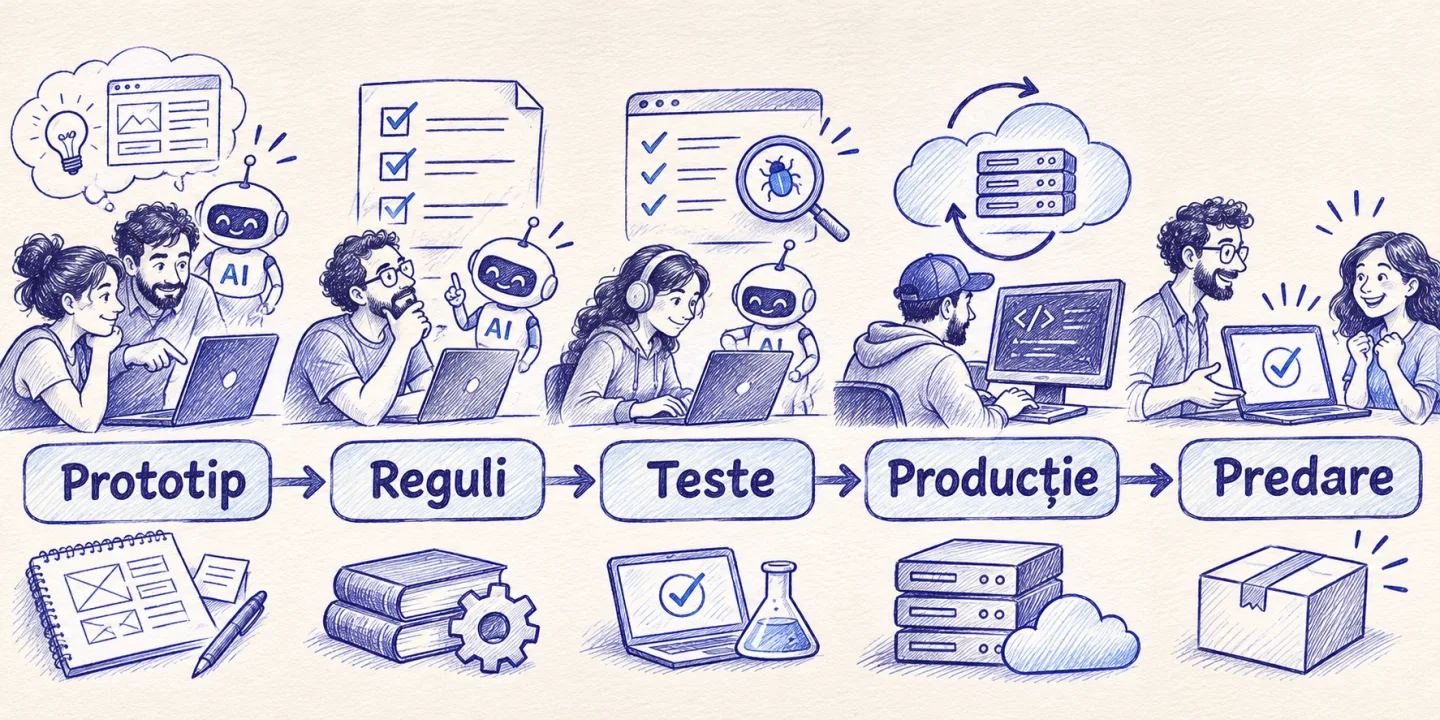
Software development in the AI era still starts from a business problem, but has other costs for exploration and implementation. A prototype is built quickly, and code proposals come in volumes. The expensive decisions remain those related to data, integrations, accountability and maintenance. A good product can use AI for development, have AI in its functions, or combine them after checking the value of each use.
Assume that a company wants to shorten the preparation of offers. A demo can accept a few specifications and instantly return an attractive document. In manufacturing, some services have pricing rules, others require approval, and a wrong address can change delivery terms. The modern product separates these rules from the text which can be proposed flexibly. The team can thus change the drafting model without reinventing the trade policy.
Where does AI help in development?
A code assistant can speed up understanding a module, comparing options, completing repetitive code, and formulating tests. The best result occurs when the problem is local and the success criterion can be observed. “Add a test for a canceled invoice before issue” is asking for a more easily verifiable change than “fully modernize billing”.
In exploration, use propositions that you can counter. Ask for two data models and see what the same case looks like in each. If an old application has orders closed before the last payment, take one as an example and check what happens on import. This exercise tells you more than the speed at which the schema is generated. For production, make sure the team can explain the migration, compare the numbers, and come back if there are differences.
When AI is part of the product, it moves the binding rules into the code or decision-making service. The model can interpret a free message, and the application checks that the output has the correct form, that the person has access, and that the resource is in a compatible state. The separation simplifies testing and leaves the team free to consider another model at the next cost review.
What does an architecture suitable for business look like?
Initializes the domain model. For offers, it explains the difference between request, draft, approved offer and submitted offer. Defines who can switch between states and how an approval expires. If the names used in the software reflect these terms, people can more easily verify the behavior in a log, report, or support chat.
Keep important data in a system of record that the organization can export. Attachments can come from another app, messages from a separate channel, and draft from a model. The application must know the source of each important field. A draft that says “this rate is from the active catalog” gives the reviewer verifiable information. Without it, the specialist resumes the search from the beginning.
Keep the interface close as well. For an operator with open files in multiple applications, a screen that shows the next step, missing information, and approval history can be the most valuable component. Animations and instant generation only help if the user can identify in seconds what they need to do. Prototype with a form, list, and detail view before investing in a universal assistant.
When are you buying, configuring or building?
| Variant | When it makes sense | What do you check before? |
|---|---|---|
| SaaS | Standard process, fast access, few peculiarities | Cost after growth, export, permissions, integration |
| Configured solution | Common core, company-specific rules and sources | What you can change yourself and who maintains the integrations |
| Own development | Distinctive rules, deeply integrated flows or required control | Operating budget, delivery route and responsibilities |
| Spot modernization | Functional system with a bounded deadlock | How to measure deadlock and how to get back to the previous flow |
When comparing variants, write the same scenarios for all vendors. Choose a common case and a few exceptions, such as a duplicate request, a customer without complete data, and a change after approval. Ask to see what happens from input to output. If the provider presents a static capture, ask how the result is corrected and what traces remain after the change.
For a differentiating process, it may be worth owning your own logic and buying off-the-shelf infrastructure. For messaging, storage, or authentication, the cost of a scratch implementation can eat up your budget with no commensurate benefits. The limit changes depending on scope, volume and contractual requirements. Comparison of SaaS, Preconfigured Solutions, and Development from Scratch details the tradeoffs.
How do you use assistants without increasing the amount of code to review?
Define the limit of change before asking for implementation. For an export feature, describe who uses it, the fields included, what happens with large volumes, and how data is protected. Request a patch that fixes the function at the normal entry point. If reformatting, new abstractions or dependencies appear, check what they are for and whether they need to be delivered in the same change.
Maintains an implementation-independent set of checks. A team can test a flow with example contracts, a permission matrix, and a simulation of broken integrations. The reviewer tracks the primary route and reconnection situations. For a compound write, check what’s left if the secondary service responds late and how to avoid repeated effects. A result that works in a local script must also be confirmed from the application used by the client.
It measures how easily another colleague can review and pick up the change. A diff that has a purpose, a test, and a fallback plan can be quickly verified. A large bid made up of dozens of small proposals can exceed the team’s capacity even if each proposal seems reasonable. Choose batch size based on what can be understood and evaluated, not based on generation speed.
How do you evaluate an AI feature before release?
Make a set of entries that includes regular, incomplete, contradictory, and off-target cases. Handwrite what is accepted in each case. For a draft offer, for example, the text may vary, but the list of services and mandatory conditions must match the source. Missing data should be reported. If producing a result can cause a commit, keep an approval stage.
It evaluates the components and the entire flow. A good search can return the correct document, and a pattern can assign the conclusion to another section. An interface can present a correct proposal without marking the difference from the old version. Technical checks show where the error occurs. Observing a user in the actual task shows whether the error ends up mattering.
When you change the model, prompt, or accessible documents, rerun the examples and see what changes. It also compares latency, cost and error distribution. A cheaper model may be suitable for classification and a more expensive one for ambiguous cases. If you’re using cross-model routing, test the behavior when the main model isn’t responding. Keeps a way to get back to the regular process without losing requests.
How do you deliver a solution that can evolve?
Write instructions for installation, publishing, recovery, access rotation, and debugging. Includes systems structure, source of truth, and manual states. Assign access to the appropriate roles and verify in a session where someone else reboots the environment and plays out a simulated incident. A video of the demo can help guide you. Verified procedure is what allows the team to act without the original author.
For an AI flow, document the model or configuration version, volume limits, and where the evaluation sets are. It includes the person who receives the alerts and the person who can turn off the feature. If the model becomes unavailable, the operator should find the requests in a queue or list with clear state. For vendor changes, test data export, source update, and behavioral differences before changing access to production.
Keep the gauges easy to read. It’s useful to know how many offers reached approved status, how many requested corrections, and how long the process took. It is less useful to collect many logs without a connection to the result. For development and handover risks, compare procedures with NIST’s SSDF Profile for Generative AI.
How do you choose modern tools for a business solution?
Separate design, development and execution tools. A prototyping tool can produce multiple interface variants and allow for early testing. A code assistant can help implement a separation between rules and data. A workflow engine can schedule jobs and keep states. A model in the application can interpret text. The four options have different access, upgrade and cost requirements.
Start with a single route demo. For a quote, design the form and approval screen, enter two dummy requests, and watch the team react. When the solution generates a draft, it displays the confirmed data and what is still missing. An attractive aspect also comes from the hierarchy of information, the precise text and the avoidance of redundant steps. Ask for feedback on what the user can find, not just visual design.
For technical selection, compare license, export, data sent and level of effort to a change. If the workflow engine cannot represent an expiring approval, an additional component may be needed. If a prototyping tool produces code, it verifies that the structure fits into the application and that the team can maintain it. The choice does not have to be the same for the demo and the final product.
How do you modernize a process without stopping the activity?
Choose a clear separation. For example, the old system continues to issue offers, and the new application prepares the form and transmits the approved fields. In the first stage you can observe results in parallel. Check the number of cards and important values with the reference. If differences occur, identify the rule, version, and source before deciding whether to migrate the final order.
The migration includes historical information, including states that the new flow no longer creates. For each state, decide whether it can be read, modified or just archived. It also checks exports, notifications, and other format-dependent apps. In a transitional stage, a reconciliation export can be as important as the new screen. It shows the team if the volume and values match.
Set a comeback in advance. If an error occurs, what requests go back to the previous process, what was written in the meantime, and who owns the redo list? You can limit the activation to a category of users or request types. A gradual migration builds evidence of what works and gives the team time to learn the new states.
What does a delivery note for the tender example look like?
Write the purpose in operational terms: the operator can take a request, check the identified elements and submit an offer after approval. Add two cases. In the first, the model recognizes the service and the app reads the valid rate. In the second, the description refers to two services, and the system asks for clarification. It also lists who sees what statuses, where the approval is stored, and what happens if the request is resubmitted.
Write down the results that you can use for a decision. For a commercial team, these might include time to draft, number of clarifications, rate of price correction, and extent to which the approving colleague sees the source. For engineering, monitor for incomplete commands and unstable dependencies. When the data contradicts the impression from the demo, investigate the difference before expanding.
In the last section of the sheet, record two alternatives if the budget changes. You can reduce the scope to form and validation or keep the generation for a segment with uniform data. Shows how information remains available after shutdown. An alternative sheet allows a business team to decide without knowing the details of all the tools.
Frequently asked questions
Can a small team upgrade a product without a rewrite?
Yes. Choose a stable flow, define an entry point and add measurement, a better interface or limited integration. Keep the source of truth in the existing system until you can compare the results. A rewrite becomes justified when system limits prevent useful changes and the cost of the transition can be managed.
How do I choose an AI tool for developers?
Choose based on integration with existing tools, permissions, retrieved data and quality of results on real tasks. Compare overhaul and maintenance time in addition to time to first proposal. Test on approved repositories and materials.
What is the first useful delivery?
A small delivery takes a real case from input to output. For bidding, this can be a form, a checkable draft, and an approval. For support, a search with sources integrated into the operator screen. After the process works, you add volumes, exceptions, and other channels.
Where does your product start?
Get a real request, data model and list of interveners. Find the point where the team is wasting time or making errors and turn that point into a measurable experiment. The modern product wins when the flow becomes clearer for the customer and easier for the team to change. If you already have a system that needs to be expanded or handed over, check out the full-stack architecture and development service.