AI audit for businesses: which processes should you automate first?
How do you prepare an AI audit for the company, evaluate the processes, choose a pilot and ask for results that you can verify.
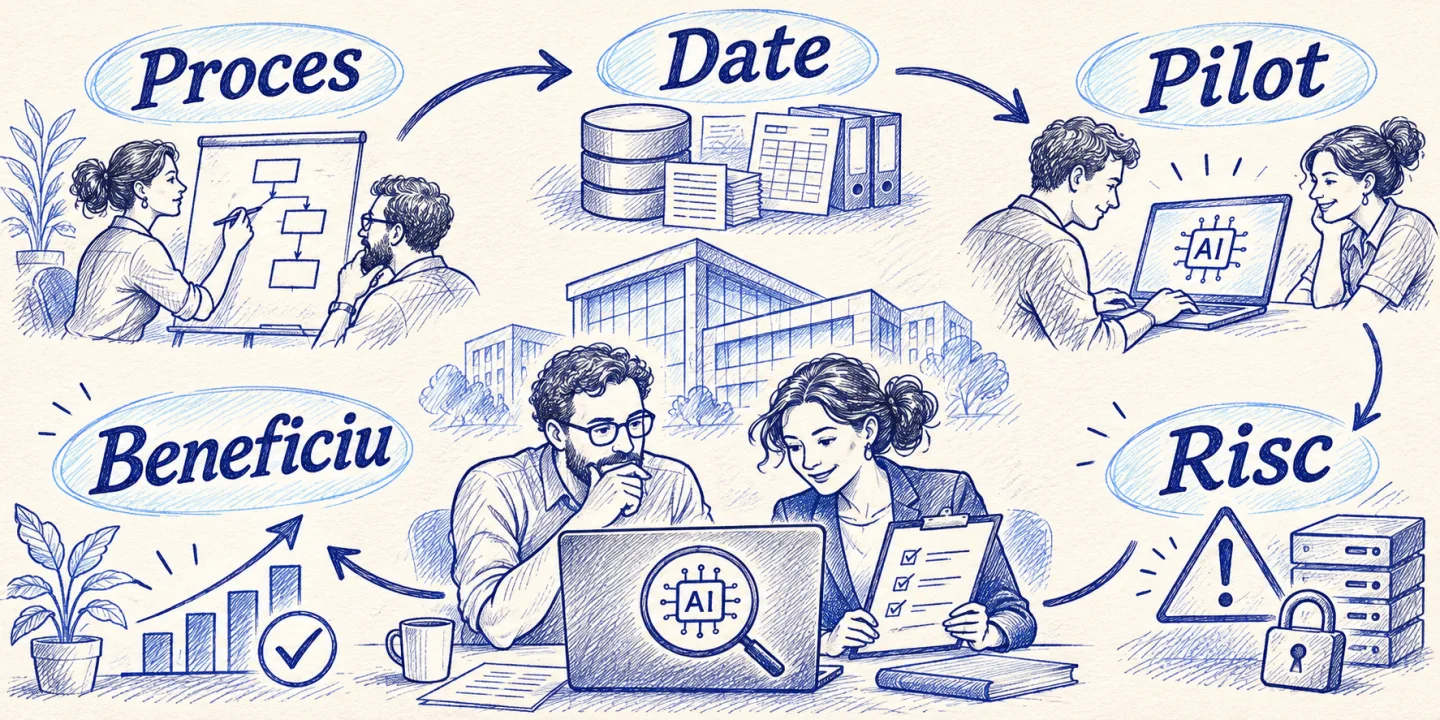
An AI audit for businesses identifies processes where automation can improve a measurable outcome and verifies that the data, rules and team enable implementation. At the end you should have a reasoned list of processes, a defined pilot and explicit reasons for postponing other ideas. A first audit can follow a single department and start from the examples the company already has.
In a hypothetical scenario, a business receives requests via form and email. Management wants a chatbot, the sales team wants automated offers, and operations wants to stop copying data between applications. The audit may discover that all three problems start from the same lack: there is no common structure for the requests received. The first investment might be a form and a worksheet with a few fields extracted, followed by time-to-retrieval.
What do you get at the end of an AI audit?
Ask for a description of the current process, with inputs, systems, responsibilities and output. The chart should include the common case and the exceptions encountered. For a quote, you’ll see where the message is coming from, who’s asking for additional information, where the rate is calculated, and who can send the response. A strong conclusion links the recommendation to a problem observed in this pathway.
Then ask for a prioritized list of assumptions, costs, risks and evidence. A data mining proposal is worth evaluating through examples and an estimate of patching time. An internal search proposal is worth checking through document status and access rights. For ideas that do not make it into the pilot, note the condition where they are worth re-examining. This can be the emergence of an API or the appointment of a data controller.
The third delivery is a pilot sheet. It includes purpose, users, access, reference, acceptance criteria, term and return plan. Ask to be able to use the documents with another team. If the deliverables only exist as a presentation that doesn’t show where the estimates come from, it will be hard to explain the prioritization after a few months.
What do you prepare before the discussion?
Collect one common and one difficult case for each candidate process. You can use anonymized or synthetic examples that preserve structure. A difficult case could be a request with two intents, a wrong version of a document, or a step that depends on a delayed approval. Good examples contain enough detail to show what information changes the decision. Avoid sending entire or secret databases for a first discussion.
Note the apps used, the owner of each, and approved integrations. For an old system, check if there is an export or API and what rights the users have. The fact that someone can download a report from the interface does not mean that the firm can automatically extract the data under the terms of the contract. If access is unclear, include the question in the audit instead of building the premise on it.
Describes the current volume and time with the best available source. You can start from the ticket journal and complete with observations along a sample. Distinguish active waiting time. If a request takes two days to get approved, but ten minutes of actual work is done, optimizing drafting won’t remove the two days by itself. For the decision, it tells what delays are affecting customers and what errors are consuming team capacity.
How do you choose candidate processes?
| Criterion | What are you asking? | Signal worth exploring |
|---|---|---|
| Frequency | How many cases do we encounter in a typical period? | Sufficient volume for measurement |
| Clarity | How do we recognize a good result? | Verifiable rules and examples |
| Data | Can we use the necessary inputs and sources? | Allowed access and quality data |
| Reversibility | Can we correct the result before the consequences? | Draft, validation or manual route |
| Benefit | What does the customer or operator gain? | Fewer delays, corrections or transfers |
| Operation | Who maintains the flow after launch? | Responsible, budget, support channels |
Use the criteria to compare projects, not to produce a false precision score. You can separate mandatory terms from negotiable benefits. For example, permitted access to documents is a requirement, and large volume is an advantage. A process with high benefits but inaccessible documents may receive a source organization project first. A process of medium volume and good rules can be started immediately.
Choose a candidate from different areas to see where the problems are concentrated. In support, time can be wasted finding the procedure. In sales, data entry and approval. In operations, when reconciling between applications. If all ideas depend on the same integration, check its interface before budgeting for separate projects.
How do you distinguish rule processes from AI processes?
A step that has stable rules and structured inputs lends itself to deterministic automation. You can validate an identifier, copy fields between applications or calculate a date according to a rule. For free text, varied questions and documents with different formats, AI can bring value when the output is verified. A good flow lets each component solve the problem for which it is suited.
In the hypothetical case of the company receiving applications, the form provides the basic data and the service creates the record. The model reads the free description and suggests one of the allowed categories if there is enough information. The colleague sees the classification and the source before submitting the offer. When the result is uncertain, the entry goes to the manual sorting list, where it remains verifiable.
It also requires the assumption of no technical intervention. Sometimes a clear approval term, a list of standard documents or a mandatory field eliminates a large part of the errors. Compare the cost of process adjustment with the cost of building and maintaining a flow. If the automation remains justified after this comparison, you also have a more solid reference for the result.
How do you turn a referral into a pilot?
Choose a volume and group of users that allow you to observe the consequences. To extract, start with a document type. For internal search, start with a source collection with clear rules and ownership. It says what’s on target and what’s coming out of the pilot. A useful criterion could be “an operator can approve required fields without further search in most cases included”, quantified after measuring the reference.
Keep the manual route and determine when to use it. For example, a bad document remains available, with a visible status and reason. An approval process can stop generation when out-of-scope data occurs. Choose a test period and set up a mid-team discussion before the half where volume changes may occur.
Start with read access and only commit writes when there is validation, rights, and a rollback plan. A company can test a draft visible only to the operator without immediately changing the way it communicates with customers. When you add a write integration, confirm that a repeated request does not create two results and that the reviewer sees what is to be applied.
What costs does the audit capture?
It includes analysis, integration, data preparation, training and testing. After release, add licenses, model consumption, hosting, support, review and update sources. Show ranges and assumptions for volume. A solution can be cheap in the first month and more expensive when the company connects a new channel, changes the type of documents or increases the time spent on verification.
It separates capacity savings from budget cuts. If an operator gains an hour, the firm can respond faster or take on more requests. That doesn’t automatically lower your monthly bill. Take into account the result that the company wants. If the goal is to provide a response within the same working day, the main indicator can be the percentage of cases resolved on time and the impact on the customer experience.
Plan a review after the first few months. Measure differences after volume changes and review costs per case. An automation can only be useful for frequent types, and exceptions must still be handled manually. A good budget shows what happens if volume doubles and where new staffing or integration needs arise. The AI Automation Cost Guide
How do you choose between recommendations when the budget is limited?
Compare what you can use even if the pilot doesn’t expand. A common registry for requests, a read integration, or a set of labeled examples may still be useful. A prototype that only works in a temporary account can eat up budget and leave few reusable results. Choose a sequence where each step confirms a hypothesis and reduces the risk of the next step.
It also determines the cost of waiting. If errors occur a few times a year and are resolved quickly, extensive intervention may be a low priority. If the same category of requests is late every week and customers keep coming back, a small pilot can provide valuable evidence. For each option, write how long you can wait without affecting the result and what temporary measure you have available.
What does the audit result look like in a B2B example?
Imagine a company that sends offers weekly for three categories of services. The team receives bi-channel requests and checks rates across multiple files. In interviews, operators indicate that the delay comes from finding the correct version, less often from editing the text. The audit prioritizes a catalog with owner, an entry form and a common record. An AI draft goes in after these sources are available and can be verified.
The pilot sheet includes a category of service, a list of required fields and the person who approves the fare. For several weeks, the system proposes the data, and the operator compares with the original request. When the model misinterprets a quantity, the value should be corrected without the system creating a new quote. If the underlying data is missing, the request should receive a clarification status with an action for the operator.
The pilot report compares pickup time, field correction, and approval wait time. If only the first stage has improved, the audit may recommend its retention and a review of the approval rules. This is a useful conclusion even without an assistant submitting bids on its own. The firm can proceed with a proportional investment and show where it justifies the next step.
How do you ensure that the recommendation remains valid after the audit?
Defines the conditions on which the recommendation is based. For example, the volume must be sufficient, documents must have identifiable sources, and one person can approve. If a provider changes data access or the department changes its process, review the sheet before using the same estimate. A conclusion based on explicit assumptions can be updated without a complete redo of the audit.
Keep records of decisions and results in a place accessible to the team. Attach synthetic or permitted examples, mark what has been directly observed and what remains to be confirmed. Before your next investment, ask for a demonstration of the remaining conditions. Thus the audit becomes a starting point for procurement and planning, with responsibilities that you can take over even when the people involved change.
What questions do you ask operators, apart from management?
Ask an operator to show you a recent request and where they had to improvise. Ask what information would have changed his decision and when he learned it. It then asks what step it performs just to compensate for an application limit. These details can be missing from the process presentation and can completely change the automation proposal.
Also ask where the informal check appears. A colleague can compare a fare with an old document because the official list does not include the exception. If you automate the copying of fields without clarifying that rule, you’ll get an offer faster, but not a more secure one. Bring the example into the management discussion using permitted data and decide who will document the rule before the pilot.
Frequently asked questions
Do I need to buy a tool before the audit?
You can start by documenting the flow and examples that the business can use. Purchasing makes sense once you know what feature you’re looking for, who uses it, and what access they require. For a test, first determine the data allowed and what the test will prove.
How long does an AI audit take?
The duration depends on how many processes you are analyzing, the access to information and the people involved. For a narrow first step, ask for a fixed term related to a department or stream. For processes with sensitive data or legacy systems, allow time to verify obligations and documentation.
What do I do if the data is messy?
Identify the authoritative source and focus on the essential fields. Assign a person for quality, update and access. If data issues frequently change the outcome, include rule cleaning and clarification as a pre-pilot step.
How do I know the audit was helpful?
You should be able to describe the case chosen, why it was chosen, what is measured, who decides and how much the company is willing to invest until the next review. If these answers are clear, you can ask for comparable implementation offers.
What can you prepare for a first discussion?
Write on one page the process, the problem, the volume, the systems involved, and what an improvement would mean. Keep an example that went well and one that shows the crash. For projects starting from existing operations, see preconfigured AI workflows. In the discussion you can compare what is solved by configuration, by an integration and by own development.