How much does AI automation cost? Budget, usage and return on investment
Calculate the budget for an AI workflow: integration, licenses, cost per case, verification work and threshold for pilot continuation.
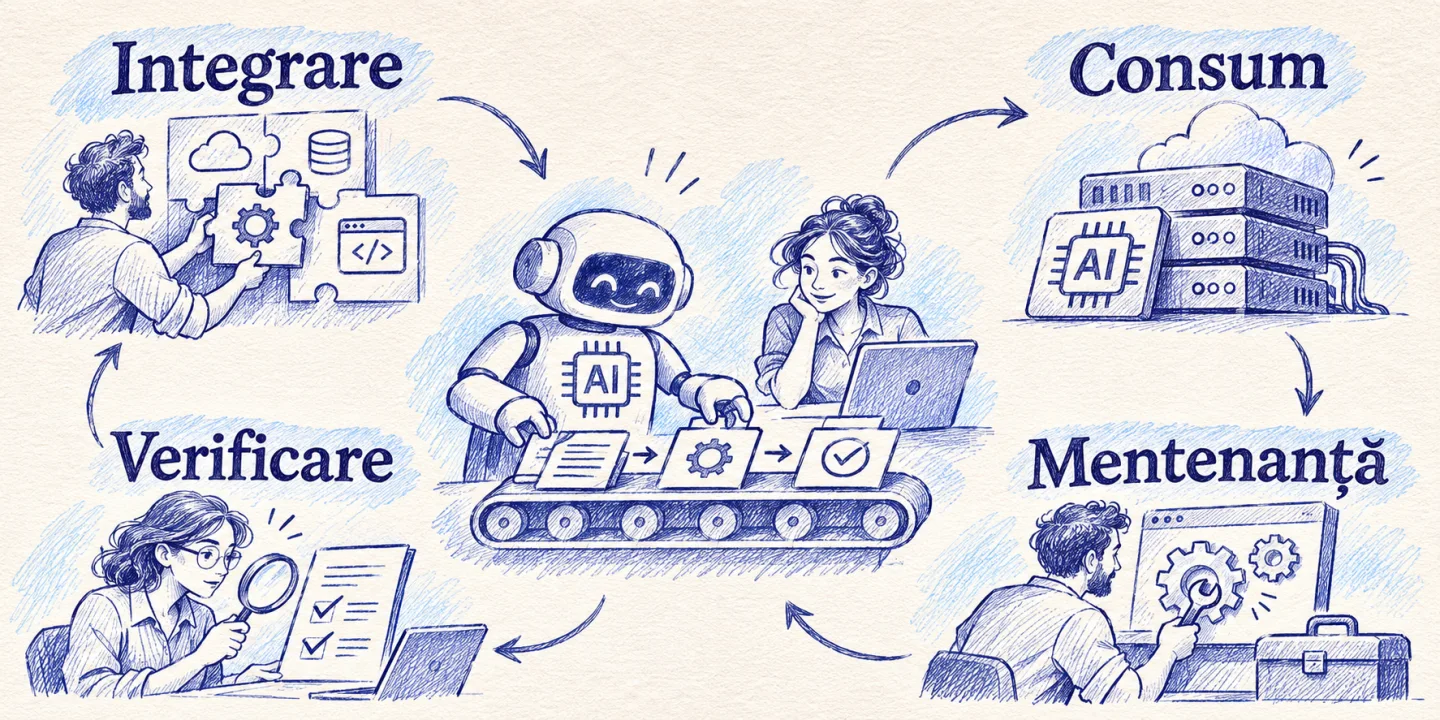
The cost of AI automation includes initial design and integration, tool consumption, operation, and human time verifying the results. The budget must be related to the volume and difficulty of the cases. For profitability, it compares the full cost to the result obtained, for example freed up working hours, fewer corrections or a shorter response time to the customer.
Two companies can buy the same service and end up with very different costs. One processes uniform documents, with a person in charge validating the fields. The other receives large attachments from multiple sources and needs approvals from multiple teams. The offer must describe how volume, exceptions and integrations change the construction price and monthly cost.
What goes into the initial budget?
It starts with flow analysis, examples and output definition. A provider needs to know what a valid input contains, what system holds the source of truth, and who accepts the output. If the rules only exist in conversations, include time to document them. A simple but undocumented process can consume more than a well-known integration.
Next comes connecting apps, configuring permissions, and preparing the interface. Checks what obligations occur when the flow reads or modifies data. Some products allow programmatic access to certain features only in a plan or with administrator approval. Building a review interface adds cost, but can significantly reduce monthly effort when the operator can review data and source in the same place.
Allocate evaluation and release separately. Includes atypical examples, interrupted processing, and reverting to manual flow. Ask to see how integration starts and stops, who has access, and where errors occur. A quote that only puts “implementation” in a line leaves it unclear what is actually being delivered and what costs will occur before it goes into production.
What does the monthly cost consist of?
| Component | What changes the amount | How do you watch it? |
|---|---|---|
| Licenses | Roles, Users, Plans, and Features | Fixed cost and growth thresholds |
| Model consumption | Number of calls, length of inputs and outputs | Cost per case type |
| Hosting and data | Volumes, indexes, files and logs | Storage and resources used |
| Human intervention | Percentage of corrections and duration of each | Minutes per completed case |
| Maintenance | Updating sources, integrations and checks | Working hours and incidents |
| Changes | New channels or new logic | Separate budget for development |
Ask the supplier for an estimate in business units, for example a hundred documents or a thousand conversations, plus the technical assumptions. A call with a long document can consume much more than a short message. A single request can include search, classification, and generation. Accounts for retrying results and periodic tests, as they consume resources even when they are not producing a new billable request.
Also watch the verification work. In many teams the most important cost may be the time of people consulting the system and fixing atypical cases. Put in a request on a regular day and ask the operator to finish the flow. Time from opening the case to saving the result, including routes to other applications. Use actual measurement in your monthly budget.
How do you calculate an indicative ROI?
Use the same period for cost and benefit. A simple model evaluates net time released, separately measured commercial benefits, and full cost. Net time is the difference between the initial time and the time after automation, including checks, corrections and administration. If you measure the time after automation directly in the full flow, the cost of corrections does not decrease once again.
Let’s take a hypothetical example. The firm processes 500 claims per month and uses six minutes for each, so 50 hours. After the pilot, the stream lasts four minutes on average, including checks, which is about 33 hours and 20 minutes. If monitoring adds three hours monthly, that leaves 13 hours and 40 minutes free. At a hypothetical internal cost of 120 lei per hour, the capacity is worth approximately 1,640 lei per month. The calculation describes the capacity, and the firm must determine what it can do with it.
It assumes hypothetical external recurring expenses of 900 lei per month and an initial investment of 7,400 lei. The estimated monthly difference is 740 lei. In that scenario, streamlined recovery would take about ten months if volume and results remain constant. If the freed up time cannot be used productively, the actual financial difference may be less. Figures are illustrative and do not represent John.Cloud rates or promises.
If the main objective is to improve the service, also track the relevant indicator. A same-day response can have value without actually cutting your budget. You can measure how many requests were fully answered on time, how many were abandoned, and how often the customer comes back with details they’ve already submitted. Report benefits separately if you can’t monetize them based on data.
How do you test volume scenarios?
Build a low-volume, regular, and high-end variant. In each, it estimates the proportion of difficult cases and the number of human interventions. The cost can change in increments when you need a higher plan or an additional operator. It also takes into account calls generated by replays, attachments that grow from month to month, and file retention time.
Compare cost per accepted result. If a variant processes many inputs cheaply, but the operator fixes a large part, the reality differs from the nominal figure per call. For a document flow, it tracks correct fields, critical errors, and time until the operator can close the case. A cost reduction that moves errors into accounting may look good on the product team’s dashboard and bad on the company’s bottom line.
Set a consumption cap and determine what happens when it is reached. For non-urgent cases, you can schedule the work later. For requests that need to be confirmed immediately, offer manual routing or basic processing. Notify the responsible person before the ceiling produces repeated blockages. The fact that a limit is configured does not mean that the product knows how to behave when it is reached.
How do you compare two offers?
Send the same representative case, the same volume and the same list of conditions. Ask separately for initial cost, monthly cost for multiple scenarios, what is included in maintenance and what is charged for changes. Ask if you will have access to sources, data, configuration and logs. In a project with personal or contractual data, check the supplier’s documents and exit procedure before choosing.
Compare demo deliverables. For example, the supplier can receive an incomplete document and show how to correct the field, how you can trace the source and where the operation is seen in the system. A flow that produces a good capture, but leaves integration, permissions and training for another step, may require more budget than it seems. Comparison of SaaS, Preconfigured and Custom Options
Clarifies what the estimate includes when demand changes. A text or threshold change can be easily configured. Adding a new channel requires integration, testing and can change data analysis. Ask for an example for both situations. If an offer includes support, ask who receives incidents, what is considered a bug, and how you document suppliers in the chain.
What threshold do you set for a pilot?
Write down the minimum result that would justify the next investment. For example, you could aim to shorten an operator’s time on a category of requests without increasing critical errors. Do the reference before the pilot and decide how you measure on the same type of case. It allows for a period when the team is learning, but shows the initial and post-training results separately.
See if you can shrink the scope. If an assistant saves time on uniform documents, you can keep this segment and send the rest to the operator. If a channel attracts many questions unrelated to the service, you can limit the function to logged in customers. In each variant it updates the volume, benefit and cost in the model. Based on them you choose to continue, modify or stop.
After the pilot, provide the team with an operating estimate and a review point. A change in supplier price, volume, or demand structure may warrant retesting. A clear contract says what happens if the project stops, including what data and documents the firm receives. AI Audit Guide and Process Selection
How do you arrive at an estimate without sending sensitive data?
Submit a format description and a synthetic example. An example can preserve length, number of fields, document type, and exceptions, without preserving actual names or prices. It tells how many apps are involved and what permissions the stream would require. A specialist can outline a range on this information, with assumptions to be confirmed by an approved test.
Also show the systems public documents, if any. For an ERP or CRM, it is important to know what operations are available and whether there is a test environment. If access is not yet established, ask for an estimate with two options, direct integration and export processing. The difference may change the order of investments.
How do you build a sensitivity table?
In the example with 500 requests, change the volume, net time per case, and the cost of verification in turn. If the volume is halved, the fixed cost remains largely the same and the hours released are reduced. If the proportion of difficult cases increases, the average time of four minutes should be measured again. Keep one column for the common case, one for the conservative case, and one for the spike. This table shows which assumption can change the investment decision.
You can calculate the threshold for recurring costs separately. If a case saves one minute net, and the illustrative internal cost is 120 lei per hour, the capacity value is two lei per case. For a recurring fixed cost of 900 lei and no other costs, the hypothetical threshold is 450 cases per month. If variable costs occur per case, subtract them from the unit value before dividing. If the remaining unit value is zero or negative, the increase in volume does not cover the fixed cost through this mechanism.
Include the initial investment when looking at recovery. If the solution only produces value in certain months, use a monthly table, not a constant average gain. Separate seasonal changes and training costs. For a budget decision, a simple calculation with the assumptions in sight is easier to verify than a percentage of return broken down by volume and time.
Who Tracks Cost After Launch?
Assign recurring costs to one person and change decisions to another, if roles are separated. In a small firm, the same person may do both. The important thing is to have access to consumption, results and the necessary logs. A monthly report should say why the cost has increased: more cases, longer entries, more corrections, or a change of provider.
When an increase occurs, check the situation with a sample. A new long attachment may consume more, but it can also bring more time saved for the operator. A change that increases cost and does not improve the outcome can be withdrawn or limited to cases where it matters. Keep a record of thresholds and decisions so that the next budget review starts from comparable data.
How do you budget for switching providers or shutting down?
Ask for an indicative cost for exporting, rebuilding the configuration and revalidating the rules. Some data moves directly, some needs to be re-indexed or converted. If you have an evaluation set and flow documentation, you can compare another vendor on the same requests. Includes parallel work time and the ability to fall back to the manual channel if the migration takes time.
Keep this scenario separate from the normal monthly cost. It becomes relevant when there is a contractual change, when the solution no longer serves the volume or when the company abandons the function. At first you can check the export on a fictitious batch. The exercise may reveal that you have access to raw data, but not statuses or approval history. Ask for the cost and procedure for the matters that matter in your field before signing.
Frequently asked questions
How much does an AI workflow cost for a small business?
The cost depends on the number of systems, the state of the data, the volume and the consequences of an error. Ask for an estimate for a clear process, with the initial cost separated from the operation. For comparison, send the same examples and volume ranges to all providers.
What costs are often omitted?
Human checks, document updates, retries, support, and change integrations may be missing from the starter offering. Ask who is responsible for each and how it is measured. Include shutdown and handover procedures in the project budget.
Can the cost be fixed?
A well-defined stage can have a fixed price. Operation often has variable components such as volume, storage, and interventions. Ask for ceilings and a way to notice when the cost is approaching them. A consumption estimate must be linked to verifiable assumptions.
What information makes the estimate better?
Prepare the monthly volume, a regular application, an exception, the necessary applications and data. Note the current time and what trading result you are aiming for. If you need to compare a simple automation with an AI-assisted one, see the AI workflow service. With this information you can discuss a pilot, a budget limit and what data needs to be obtained before scaling up.