How to choose an AI provider: questions, demos and contracts
Compare AI vendors on the same scenario. Check integration, data control, recurring costs, support and project handover.
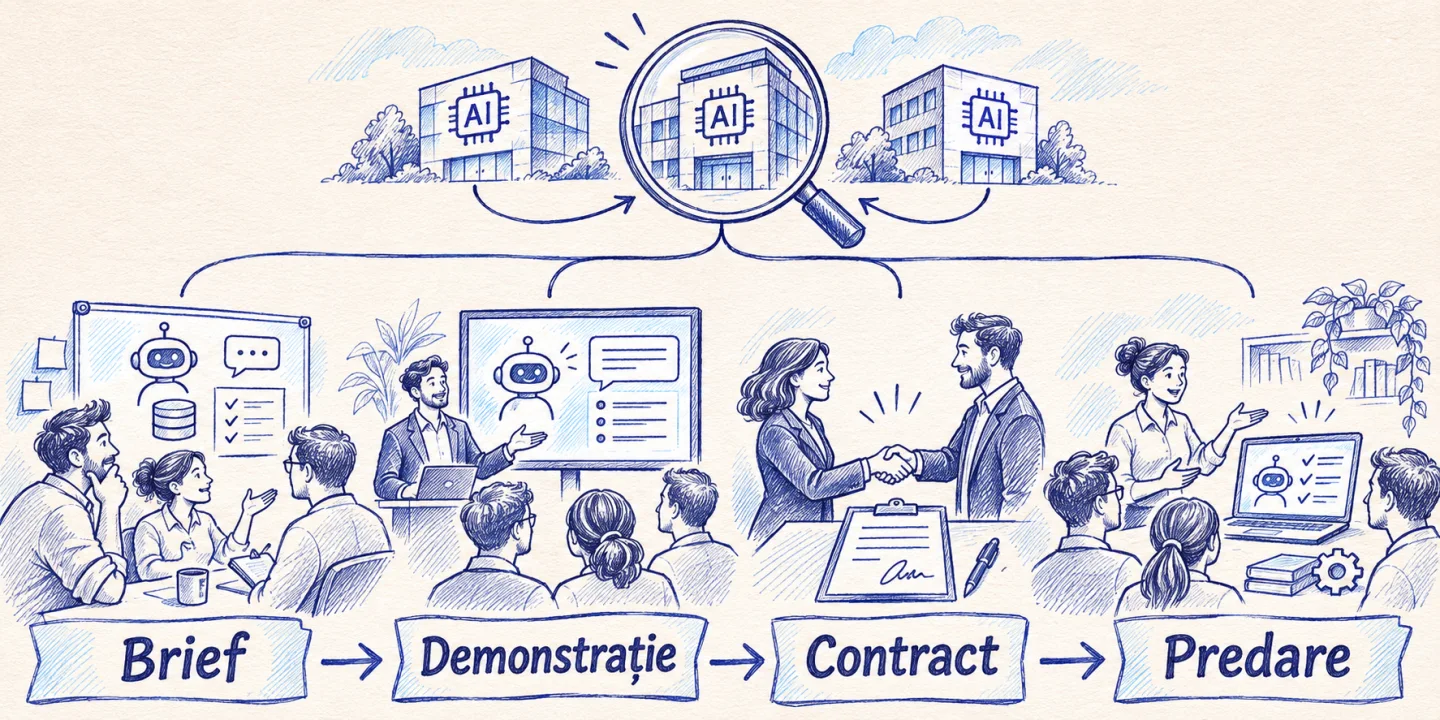
You choose an AI solution provider by putting several offers in front of the same process, with the same examples and limits. Check what ships, how it works on hard cases, who controls the data, and what happens after release. A helpful demo shows how to debug, stop, and commit the stream, in addition to the representative situation where it works well.
Imagine a company looking for a procedural response assistant. One offers ready-to-buy licenses, one sets up a private assistant, and another builds a portal. For comparison, the firm must define what procedures it uses, who can see each source, and how it verifies a response. If each vendor chooses their own demo data, the results show their presentation capability, not their compatibility with the process.
What do you write in the RFP?
It starts with the problem, the users and the observable consequence. “We want a chatbot” names a solution. “Operators waste time searching for applicable policy and sometimes provide outdated information” allows comparison between search, source organization and generation. Note how often the problem occurs and what happens when the answer is wrong.
Describes the systems and information available, without sensitive data at first discussion. For a support assistant, it indicates where documents come from, how often they change, and what roles need to be differentiated. If the project also needs access to commands, say whether it is read or modify and who authorizes these operations. A supplier can estimate better when they know exactly where system liability begins and ends.
Includes acceptance criteria. For a response from procedures, ask for the source, the version, a useful output when there is evidence, and refrain when there is none. For form integration, require reconciliation and no duplicates when the user resubmits. It includes a term for the pilot and what would justify the extension. If the goal is still vague, start with an AI audit and process prioritization.
What should you see in the demo?
It requires a complete path from request to usable result. For the procedures assistant, ask a question about a rule present in an allowed document. Check if the answer points to the section and if you can open the source. Then use a question that the documents don’t answer. A helpful response tells what information is missing and where the operator can continue.
Includes a case where two sources have different versions. It asks which rule sets the applicable document, who updates the source, and how long an old answer remains available. Check access through two test accounts with different rights, using dummy documents. This exercise shows if the permissions work through to the output and preview.
Ask to see what happens if an external service responds late. A demonstration may use a controlled simulation. The request, status information, and a continuation path should remain in the interface. In the log you should be able to find the cause without exposing data from another account. A provider that can show recovery gives you a picture of the operation, not just the initial effect.
How do you check the fit with your data and systems?
Ask for a one-page diagram of the inputs, storage, subprocessors, and outputs. It marks where the user authenticates, how rights are applied, and where information can be exported or deleted. Ask for explanations for differences between original documents, indexes, conversations, logs, and backups. A contract may use the term “customer data” without detailing how all these categories are treated.
For integrations, learn what interfaces are supported and what happens when your app updates. A read connector may be enough to start with. Writing an order, triggering an email or changing a status requires additional authorization and return decisions. If an operation can be triggered twice, require proof that the result is kept consistent.
Review model editor roles, retention, and terms by project. It asks what data remains under the company’s control, what goes to other services and what happens after termination. If personal data is processed, it involves the persons responsible for data protection. For products with significant effects, check the applicable scope and supplier documentation. Guide to Security, AI Act and GDPR
What questions differentiate the offers?
| Question | What do you want to see? | Signal that still needs to be clarified |
|---|---|---|
| How do you confirm the result? | Examples, criteria and measurable results | Prepared conversations only |
| What access does each integration require? | Roles, operations and verification | Global access without justification |
| How do you handle exceptions? | Manual route and clear status | The promise that the model will solve everything |
| How is the monthly cost calculated? | Volume, assumptions and thresholds | A price without conditions of consumption |
| Who gets the alerts? | Person, channel and assumed times | Unspecified support plan |
| What do we get for teaching? | Access, exports and documentation | Unclear vendor account dependency |
Submit the questions in the same format. If a supplier makes an assumption, document it and see how it affects the offer. You may find that the low price includes only one channel and read access, while another offer includes setting up approvals. Compare for the same purpose before negotiating the cost.
Separates mandatory conditions from weighted criteria. An access requirement can eliminate a variant even if it would have a good price. For the others, compare integration effort, sample results, time to launch, and teachability. Write the reasons for the decision in plain language. After a few months, the team can check whether the reason has remained valid or whether an assumption has changed.
How do you read costs and obligations?
It calls for a distinction between deployment, consumption, support, and changes. The estimate should indicate the volume and number of users from which the price changes. Ask who pays for retries and how you track usage before a surprise bill. For a multi-month project, ask for a regular volume and a spiked version. Calculating the cost of automation with AI
Check delivery obligations and acceptance conditions. This can be documentation, configuration, project access, data export and, when agreed, code. Third-party licenses and hosted components may have separate rules. Require the offer to explicitly name the owner of each item and what rights remain after termination. For contract and personal data, ask the relevant questions to qualified persons.
Define support by situations, not just a number of hours. What if the system stops indexing a source? Who sees that the answers have lost a section? What changes are included and when does separate estimation become necessary? Distinguish between receiving a complaint and resolving it. For outages, determine which route your team can take until remediation.
How do you test collaboration before scaling?
It proposes a short stage, paid after the agreed offer, with reusable results. It can include a flow, an evaluation set, and a to-do list before production. It defines who makes the documents available, who approves the use and who validates the output. Each dependency should have a responsible person and a check-in deadline.
At this stage, also observe how the provider communicates. If a document cannot be used, explain why and what alternative exists? If the results are weak, show examples and change the assumption? A modern project has enough uncertainties that being clear about them is more important than presenting a perfect plan. Ask for a report of what has been checked and what remains open.
Finally, check the download. A colleague in the company should be able to find a request, check a source and stop an integration with the right access. If no one succeeds without the consultant’s account, the reception does not demonstrate that the solution can be operated. A small handover test can take place before the expansion, when a problem is easier to fix.
What questions do you have about design and adoption?
Ask to see the screen of the person who will work with the product on a daily basis. She must be able to understand the source, correct a proposal, and continue manually. In a high-volume team, the difference between three screens and one can change the entire profitability. For customers, check the language used, accessibility and transfer route to a person.
Invite a real user of the process to the demo and give them a few minutes without guidance. Notice where they look for information and what assumptions they make. Ask how long it takes them to complete an application and what they should check in the existing system. If the demo only works when operated by the person who built it, it still needs tweaking before release.
How do you compare offers in a decision meeting?
Prepare a sheet with the same fields for each offer. Put mandatory requirements first, such as role-based access or keeping data in an approved environment. Attach evidence from the demonstration or documentation. A requirement left without proof should be marked as open. For negotiable criteria, write down the impact in plain language: what the team saves, what it can maintain, and what costs arise from the change.
Imagine two offers for the procedural assistant. The first starts quickly, but requires a manual export when updating each document. The second integrates the source directly and has a higher initial cost. If procedures rarely change, the first option may be sufficient. If they change weekly, the maintenance and risk of responding with an old version may matter more than the price difference. Request an update scenario and measure the effort for the same document.
It also presents the deferred decision. You can select a pilot for a group of users and leave the integration with a sensitive system for a later stage. It says what will trigger the next stage: sufficient results, clarified rights and acceptance by the team. This allows comparison of options without turning the entire architecture into an irreversible choice from the first order.
What do you check in the exit plan?
Turn the exit into a small test before long-term contracting. Request a sample export and check the format, data bindings, and import documentation. It asks if indexes or configurations can be moved and which components need to be rebuilt. For a project that includes code, set the repository, permissions, and runtime instructions. For a SaaS, be aware of the data available after the close and the takeover deadline.
Clarifies what happens with supplier and subcontractor access. A concrete plan shows who revokes permissions, what data is deleted or kept according to the agreement, and how you confirm completion. Then simulate a simple incident to see if your team can continue manually and respond to customers. The purchase decision is more solid when you can also evaluate a change in direction.
How do you compare an integration offer with a replacement offer?
Ask each vendor to show what part of the flow they are changing and how it coexists with the current system. For integration, see who maintains the connector, which fields are duplicated, and how to fix differences. For replacement, require a history migration, training and verification plan before decommissioning the old application. These costs can exceed the effort of building the AI function.
In the procedures scenario, a new product may offer better search, but it doesn’t need to become the place where documents are approved. A connector can keep the existing process and publish only the current versions to the assistant. If the team also has drafting, approval, and external exposure issues, they can then compare a larger upgrade. Separate the two decisions in the offer so that the pilot can be accepted or extended based on its results.
Frequently asked questions
SaaS or custom development?
For a common process, a SaaS may be sufficient after checking access and export. For specific rules and existing systems, compare the setup with your own development. Ask for the same examples for both and analyze the cost of ownership. Comparison between preconfigured solutions and development from scratch
What does a turnkey project mean?
The expression can cover different things. It describes what the firm receives upon acceptance: integrated data, active environment, roles, training, documentation, operating procedures and any rights to the agreed code. What is missing must have a responsible and an estimable cost.
What if I can’t send real examples?
Prepare synthetic entries with the same structure, length, and exceptions. Ask for a demo on them first. For the real-data pilot, use an approved environment and agreement with limited access. Also check how copies are retired after the test.
How do I compare vendors with different architectures?
Compare output, limits and total cost for the same process. One of the variants can have its own storage, the other managed services. Ask to see the data path and operation mode for each. Choose after checking the mandatory requirements and volume assumptions.
What do you send for the first chat?
Describe the problem in a paragraph, add the applications involved, the approximate volume, and an example of an exception. Say what cannot be changed and how you will decide that the project has succeeded. You can use this sheet when discussing AI solutions for business and when requesting other offers. A common brief keeps the comparison anchored in the actual way the firm works.